Becoming a Dutch Citizen: Rules, Exam and What You Give Up
By Jannú Frutos
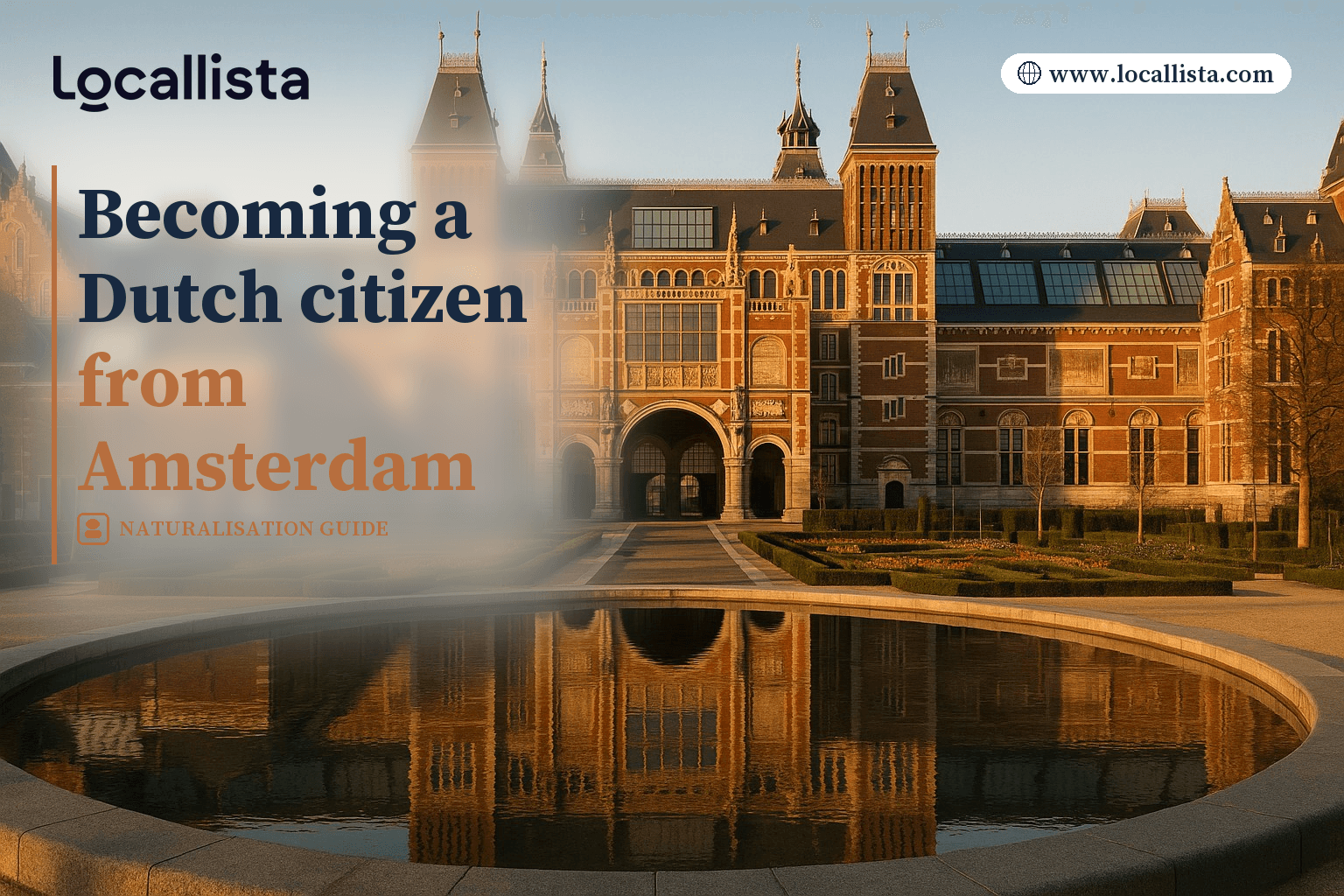
You've built a life in Amsterdam and you're wondering about a Dutch passport. For most internationals the route is naturalisation. That means five years of legal residence on the right kind of permit, a Dutch exam at A2 level and, unless an exemption applies, giving up your current nationality. Some people can use a faster, cheaper route called the option procedure. Here's how it works, what it costs and what you'd give up.
A quick note first. We checked everything below with the IND (the Dutch immigration and naturalisation service), DUO and the government. Fees change every 1 January and stricter rules are being debated, so open the linked pages before you apply. This is practical guidance, not legal advice.
The short version
- Five years is the rule today, in a row, with every permit extended on time.
- Your permit has to be non-temporary, like permanent residence, EU residence or highly skilled migrant.
- You need the integration exam at A2, or a state exam NT2 diploma at B1 or B2.
- You'll usually give up your other nationality, unless you're married to a Dutch citizen or were born here, among other exemptions.
- The option procedure is faster for some, with no exam and a lower fee.
- You apply at the gemeente, in Amsterdam the Stadsloket Centrum.
- You're only Dutch after the ceremony, which you must attend within a year.
Who can become Dutch, and after how long
The standard route is naturalisation (naturalisatie). You can apply if you're 18 or over and have lived in the Kingdom of the Netherlands for five years in a row on a valid residence permit. The IND also checks that you always applied to extend your permit on time. A gap between two permits breaks the run, so dig out your old permit dates first.
Some people can apply sooner. The IND's list of exceptions includes these:
- Married to, or the registered partner of, a Dutch citizen. You can apply after three years of living together, and those years can even have been abroad.
- Living with a Dutch partner without being married. Three years together in the Kingdom also counts.
- You lived here before. Two years in a row now is enough if your total time in the Kingdom adds up to ten years or more.
- You're stateless and registered as such. Then it's three years.
One detail catches couples out. The IND wants the same Dutch partner for the whole three years.
The residence permit you need to hold
Not every permit counts. From your application to the ceremony, your residence has to be what the IND calls non-temporary. On its list of residence purposes, these qualify:
- A permanent residence permit, or a long-term EU resident permit.
- A permit with a non-temporary purpose, such as highly skilled migrant, European Blue Card, self-employed, or work with free access to the labour market.
- Living with a family member who's Dutch or holds one of these permits.
- Residence as an EU, EEA or Swiss citizen. You need no permit, and it counts as non-temporary after three months.
- For British nationals, a Withdrawal Agreement residence document.
Study, the orientation year for graduates, intra-corporate transfer and seasonal work don't qualify. Nor does living with a partner whose own permit is temporary. If that's you, you'll need a non-temporary permit first. Whether earlier years on a temporary permit count towards your five is worth checking with the IND or the gemeente.
Whatever you hold, keep it valid, because it has to be valid on the ceremony day too. On a work permit? Our guide to the highly skilled migrant permit covers renewals.
The integration exam: which one and which level
To naturalise, you have to show you've integrated, which means passing the integration exam (inburgeringsexamen) at language level A2. You book it with DUO, the government agency that runs it. A2 is a basic level, enough for simple everyday conversations.
This surprises a lot of internationals. Under the integration law, permits like highly skilled migrant and Blue Card count as temporary, so you were probably never obliged to do inburgering. For citizenship, those same permits count as non-temporary, and the exam still applies. EU citizens are in the same position.
According to the IND's civic integration page, the exam is made up of these parts:
- Dutch language: reading, listening, writing and speaking, at A2.
- Knowledge of Dutch Society (KNM): questions about how the country and its society work.
- Orientation on the Dutch labour market (ONA). You're exempt if you've reached state pension age. You're also exempt if you've worked here as an employee for at least 48 hours a month in six of the last 12 months.
- The participation statement (PVT). If you were never obliged to integrate, you skip this part.
What it costs. DUO currently charges about €50 for each exam part, and €40 for ONA. Check the latest prices on inburgeren.nl before you book. DUO also has free practice exams for every A2 part, so try those before you pay.
Other ways to meet the requirement
- The state exam NT2 (Nederlands als tweede taal) at B1 or B2. Its diploma counts instead of the integration exam, so it's worth a look if your Dutch is already beyond A2.
- A Dutch diploma from education above primary level, taught in Dutch. Eight years of school here between ages 5 and 16 also counts, as do some international diplomas with a pass in Dutch.
- A medical dispensation if illness or disability makes the exam impossible, based on advice from Argonaut, the government's medical adviser.
Tried hard and still can't pass? After at least 600 hours of lessons at an approved school and at least three exam attempts, you can ask DUO for advice on your case.
Giving up your other nationality
This is the part people think about longest. If you're 18 or over, you're asked to renounce your current nationality after you naturalise. It's called the afstandseis, and it applies to EU citizens too.
The IND's renunciation page lists the main exceptions. You keep your nationality if one of these applies.
- You're married to, or the registered partner of, a Dutch citizen on the date the Royal Decree making you Dutch is signed. Marrying after that date doesn't count.
- You were born in the Kingdom of the Netherlands and live here now.
- You hold an asylum residence permit.
- Your nationality belongs to a country the Netherlands doesn't recognise, such as Taiwan.
- Your country's law doesn't let you give up its nationality. The IND keeps a country list.
You can also ask for an exemption if renouncing would hit you hard. The IND's examples are a large payment to renounce, losing rights worth a lot (an inheritance, say) or having to do military service first. You ask when you apply, with documents to back it up, never afterwards.
If you do have to renounce, the IND sends you a letter after the ceremony. From then you have three months to send proof that you've asked your country to end your nationality. That usually goes through its embassy or consulate, and it costs time and money. Ignore it, and the IND can take your Dutch nationality away again.
Two more things to know. Some countries end your nationality automatically when you become Dutch. And once you're Dutch, voluntarily taking another country's nationality normally means losing the Dutch one.
The option procedure: a faster route for some
The option procedure (optieprocedure) is a simpler way to become Dutch, open to specific groups. There's no integration exam, you can often keep your other nationality, and the fee is much lower. On the IND's option page, the main groups are these:
- Adults born in the Kingdom who have always lived here.
- Adults who've lived in the Kingdom since their fourth birthday. This group does have to renounce.
- People with 15 years in a row here who've been married to, or the registered partner of, a Dutch citizen for at least three years.
- People with 15 years in a row here who are 65 or older.
- Some former Dutch citizens, after at least one year back here on a non-temporary permit.
You make an option declaration at your gemeente, which decides. By law it has 13 weeks, and it can extend that once by another 13. If you fit a group, check this route before you book an exam.
How to apply in Amsterdam
You apply at the gemeente where you're registered, not the IND. The gemeente checks your file and sends it on. If your BSN and registration still need sorting, our guide to BSN, DigiD and gemeente registration in Amsterdam covers it.
- Book an appointment. In Amsterdam you apply at the Stadsloket Centrum, and you book by calling 14 020 with your BSN ready. Check the city's naturalisation page before you go.
- Gather your documents. Bring a valid passport, your residence permit, your birth certificate and your integration diploma or proof of exemption. Foreign documents often need legalising and a translation, so start early.
- Go to the appointment. A municipal officer checks your documents and fills in the form with you. You sign the renunciation statement, or ask for an exemption. Children of 12 and over come along.
- Pay the fee at the gemeente when you submit.
- Wait for the IND. It has 12 months to decide, counted from when you pay, and it can extend that if documents are missing. You can follow your application in My IND.
- Attend the ceremony. After a yes, the King signs a Royal Decree and the gemeente invites you to a ceremony. Go within one year of the decision, or you start again. You make the declaration of solidarity, saying Dutch law applies to you too, and can then apply for your passport.
What it costs. On the IND's current fee list, naturalisation costs €1,139 for one person and €1,454 with a partner. Each child under 18 who naturalises with a parent adds €168. An option declaration is €241, or €412 with a partner. The IND changes these every 1 January, so check the list in the month you apply.
Check your record first
You mustn't be a danger to public order, and the IND's public order page spells out what that means. An ongoing criminal case blocks an application. So does a recent conviction, here or abroad, in the five years before you apply. That covers prison, 36 or more hours of community service, a fine of €900 or more, or a driving ban of 60 days or more. If any of that rings a bell, get advice before you pay.
Looking for Dutch language schools in Amsterdam?
English-speaking, screened and ranked by real reviews from the expat community.
What's changing, and what isn't law yet
You'll read headlines about stricter rules, so here's where things stand. The rule today is five years and the exam at A2.
- Ten years instead of five. The previous cabinet drafted a bill to double the general residence term to ten years. The coalition that took office afterwards left that plan out of its coalition agreement, so its future is unclear. It isn't law.
- B1 instead of A2. A draft change to the rules for the naturalisation test would raise the language level from A2 to B1, and the current government's plans also point to B1. No date has been set. Not law either.
The ten-year draft said applications made before a change would be judged under the old rules. Nobody can promise that for future changes, but if you already qualify, it's a reason not to wait. Check the IND before you apply.
What you gain, and what you give up
- You gain: no more permits to renew, a Dutch passport and EU citizenship if you don't have it yet. You can vote in every Dutch election, live abroad for long stretches and take any public job, from police officer to judge.
- You give up: usually your current nationality and the rights tied to it. Depending on the country, that can touch inheritance, or your right to live and work there. Renouncing costs money as well.
On voting, you may already have more say than you think. EU citizens can vote for the gemeenteraad (the city council) straight away, and other residents after five years. Citizenship adds national and provincial elections. One last thing: Dutch nationality obtained with false information can be withdrawn, up to 12 years later.
Getting ready: Dutch lessons and when a lawyer helps
For most people, the exam is the real work. Five years of living in English (easy in Amsterdam) still leaves A2 to learn properly. Look for a teacher who prepares you for the DUO exam specifically, including KNM, and ask how many hours they'd expect from your level.
What it costs. At the Dutch schools listed on Locallista, one level of a group course typically costs about €471 to €625, usually around 13 lessons plus an exam. One-to-one lessons run about €50 to €100 an hour. Many schools offer a free intake, and plenty of Amsterdam employers pay for Dutch lessons, so ask HR.
A simple application doesn't need a lawyer, since the gemeente goes through the form with you. One is worth it for gaps between permits, a past conviction, a request to keep your nationality, or a refusal you want to object to. For a whole naturalisation file, Amsterdam firms on our immigration lawyers page quote a fixed fee of about €2,080 to €2,580 excluding VAT. The IND fee comes on top.
Mistakes that slow people down
- Extending a permit late and breaking the run of five years.
- Leaving foreign birth certificates until the last minute, when they need legalising and translating.
- Forgetting to ask for a renunciation exemption when you apply, because you can't ask later.
- Marrying your Dutch partner after the Royal Decree is signed and expecting to keep your passport.
- Missing the one-year window for the ceremony.
Still in your first months here? Our complete guide to moving to Amsterdam shows where each step fits.
How Locallista helps
The exam is where a good teacher makes the difference: someone who knows what DUO tests and will still explain things in English.
We're a directory of English-speaking local service providers. Every business is screened before it's listed, reviews are phone-verified, and the ranking reflects real expat experience, not who paid the most. It's free to browse and free to get in touch.
Start with our Dutch language schools in Amsterdam, and ask each one about integration exam preparation and trial lessons. If your case has a complication, an immigration lawyer can tell you where you stand before you pay the IND.
Frequently asked questions
How long do I need to live in the Netherlands to become Dutch?
Can I keep my current passport if I become Dutch?
Which Dutch exam do I need for naturalisation?
Do EU citizens need to take the integration exam to naturalise?
Where do I apply for Dutch citizenship in Amsterdam?
How long does naturalisation take?
What is the option procedure?
Do I need a lawyer to become a Dutch citizen?
Join Locallista. Recommend Locallista.
Locallista is powered by your feedback. Your reviews, suggestions and ideas help everyone grow - fellow expats thrive and great local providers get the recognition they deserve.